português
 English
 français
 Deutsch
 italiano
 русский
 español
 العربية
 Nederlands
 한국의
한국의 Romania
 Bulgaria
 Melayu

Manufacturing pharmaceuticals is essentially a series of chemical reactions. Take a typical antibiotic synthesis as an example: two raw materials react in a solvent to form the target molecule. However, when the reaction is complete, the vessel contains not only the target product but also a large amount of impurities, including unreacted raw materials and by-products, acids used to maintain the reaction pH (such as hydrochloric acid, HCl), salts generated by neutralization (such as sodium chloride, NaCl), catalysts (such as palladium, platinum, and other precious-metal complexes), and organic solvents (such as methanol, ethanol, acetone, etc.). These impurities have one thing in common: they are mixed with the target product, so the target product must be purified.
Traditional reverse osmosis (RO) membranes work by blocking almost everything and allowing only water to pass through, like an extremely narrow door that only water molecules can squeeze through. This is ideal for producing purified water, but it cannot retain valuable pharmaceutical molecules dissolved in the water. Electrodialysis (ED), by contrast, operates under a direct-current electric field: cations (Na+, K+, Ca2+, and metal ions from catalysts) migrate toward the cathode, while anions (Cl-, SO42-, and organic acid anions) migrate toward the anode and enter the concentrate chamber, where they are removed. The pharmaceutical molecules that serve as the target product, if uncharged, remain in the feed solution.
This is the most classic application of ED in pharmaceutical production. After an organic synthesis reaction is completed, acids or alkalis are often added for neutralization, generating large amounts of inorganic salts (NaCl, Na2SO4, NH4Cl, etc.). If these salts are not removed, downstream crystallization, drying, and formulation can all be affected. Taking cephalosporin antibiotics as an example, the fermentation broth contains the target antibiotic molecules (MW approximately 300-500 Da) as well as a large amount of inorganic salts left from the fermentation medium. Ultrafiltration (UF) is first used to remove cells and proteins, and ED is then used for desalination. The antibiotic molecules (neutral or weakly charged) remain in the diluate chamber, while Na+, Cl-, and SO42- migrate into the concentrate chamber and are discharged. After desalination, the stream can directly enter the crystallization process. The advantage of ED is that it has almost no impact on the passage of neutral API molecules, while also protecting heat-sensitive drugs from damage caused by high-temperature distillation.
In pharmaceutical crystallization, the yield of a single crystallization step is often only 60-80%. The remaining 20-40% is discharged together with the mother liquor. The mother liquor contains the target API plus large amounts of residual salts and organic solvents. ED first removes the inorganic salts, reducing the load on subsequent treatment. After desalination, the mother liquor can undergo solvent recovery followed by secondary crystallization, or it can be directly concentrated to recover the API. As a result, the overall yield can increase from 60-80% to more than 90%.
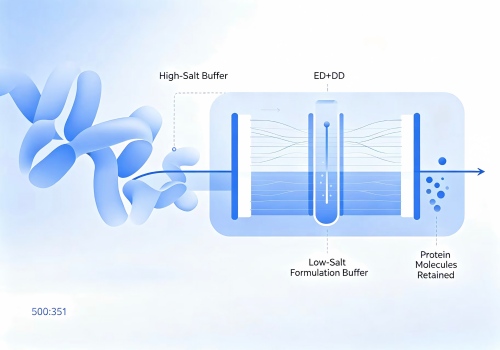
The production process for biopharmaceuticals, such as monoclonal antibodies, insulin, and vaccines, generally follows this sequence: cell culture → protein expression → purification. During purification, the protein solution often needs to be exchanged between different buffers, for example from a high-salt elution buffer to a low-salt formulation buffer. Traditional buffer-exchange methods, such as dialysis or gel filtration chromatography, are slow, consume large amounts of water, and are not suitable for large-scale production. Through an "electrodialysis plus diffusion dialysis (ED+DD)" mode, ED can reduce the salt concentration in a protein solution to the target level within several hours while causing almost no protein loss.
Pharmaceutical water has strict classifications: drinking water → purified water → water for injection (WFI). Traditionally, WFI is produced by multi-effect distillation, which consumes a very large amount of energy. Modern processes increasingly use a "two-stage RO + EDI (electrodeionization)" route: RO removes more than 99% of salts, organic matter, and microorganisms, while EDI reduces residual ions to the ppb level. The final product water has a conductivity of less than 0.1 μS/cm (equivalent to TDS <0.05 mg/L), meeting standards in multiple countries. Compared with distillation, RO+EDI consumes only one-fifth to one-tenth as much energy and does not require boiler steam.
Although ED is feasible in principle, its broader adoption in the pharmaceutical industry still faces practical constraints. 1. The drug molecule must not carry a strong charge. ED separates substances by using differences in electrical charge. If the API is strongly acidic (such as certain nucleic acid drugs) or strongly basic (such as certain alkaloids), it will be pulled away by ED just like a salt. 2. Membrane stability in organic solvents is another limitation. Many pharmaceutical syntheses are carried out in organic solvents, such as methanol, acetone, and DMF, rather than in water. Standard ED membranes, which are ion-exchange membranes based on a polystyrene-divinylbenzene framework, may swell or even dissolve in strongly polar organic solvents. Although organic solvent nanofiltration (OSN) membranes are developing rapidly, ED membranes designed specifically for organic-solvent systems are still at an early stage.
The core value of electrodialysis in pharmaceutical production is "desalination without losing the drug." It is not intended to replace RO, UF, or distillation. ED precisely separates charged salt ions from expensive pharmaceutical solutions while retaining the drug molecules. This seemingly understated technology is making pharmaceutical purification more efficient, gentler, and greener.
1.What pharmaceutical processes are compatible with this electrodialysis system?
It adapts to four core scenarios: API desalination (purification of cephalosporin and other antibiotics), pharmaceutical crystallization mother liquor recovery, protein drug purification and buffer exchange (monoclonal antibodies, insulin, vaccines and other biopharmaceuticals), and preparation of WFI by matching with two-stage RO system.
2.What effect can the equipment achieve in treating crystallization mother liquor?
It can effectively remove inorganic salts from the crystallization mother liquor, support secondary crystallization, solvent recovery and concentration extraction of mother liquor, and increase the overall API yield from 60%-80% to more than 90%.
3.What is the core advantage of the equipment in processing protein drugs?
It can quickly complete high-salt to low-salt buffer exchange for biopharmaceutical solutions with zero protein loss throughout the process, suitable for large-scale production, and solves the problems of low efficiency and high water consumption of traditional dialysis and gel filtration chromatography.



 IPv6 SUPORTADO POR REDE